Air-Cooled Environmental Test Chamber Cooling Systems
Environmental test chamber cooling systems remove heat from both the product and the air inside the chamber, lowering the temperature during testing. This heat is transferred through the refrigeration system and rejected at the condenser.
When selecting a cooling configuration for an environmental test chamber, there are two primary condenser types:
- Air-cooled condensers
- Water-cooled condensers
Each option has specific advantages and limitations depending on the application.
Integral Air-Cooled Environmental Test Chambers
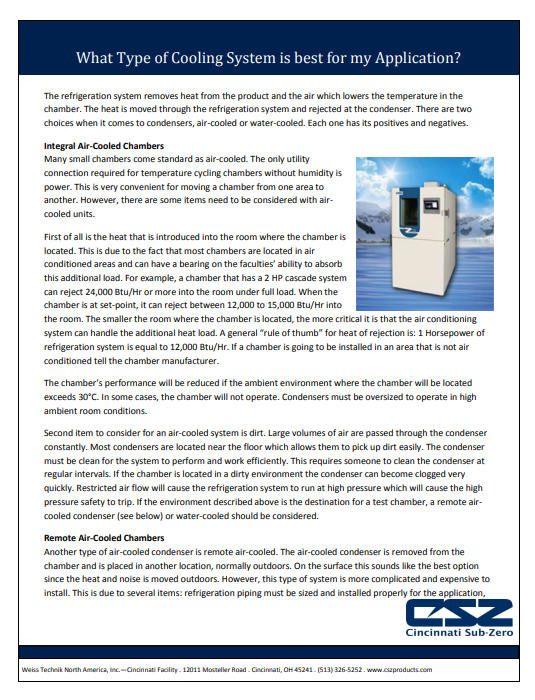
Many smaller environmental test chambers are designed with integral air-cooled condensers. For temperature cycling chambers without humidity, the only required utility connection is electrical power.
This makes air-cooled environmental test chambers convenient, particularly when chambers need to be moved between locations.
However, several important factors must be considered when using air-cooled systems.
Heat Rejection and Facility Impact
Air-cooled environmental test chambers reject heat into the surrounding room. Because these chambers are often located in air-conditioned spaces, the added heat load can impact the facility’s ability to maintain ambient conditions.
For example:
- A chamber with a 2 HP cascade refrigeration system can reject 24,000 Btu/hr or more under full load
- At setpoint, heat rejection may range from 12,000 to 15,000 Btu/hr
Rule of Thumb
- 1 horsepower (HP) of refrigeration = 12,000 Btu/hr of heat rejection
The smaller the room, the more critical it is that the air conditioning system can handle this additional load.
If the environmental test chamber will be installed in a non-air-conditioned space, this should be communicated during system selection.
Ambient Temperature Considerations
Environmental test chamber performance can be reduced if the ambient environment exceeds 30°C (86°F).
In some cases:
- The chamber may not operate
- Condensers must be oversized to function in higher ambient conditions
Airflow and Maintenance Requirements
Air-cooled condensers continuously move large volumes of air. Because condensers are often located near the floor, they can easily collect dirt and debris.
To maintain proper system performance:
- Condensers must be cleaned regularly
- Airflow must remain unrestricted
If airflow becomes restricted:
- The refrigeration system may operate at elevated pressure
- High-pressure safety limits may trip
- System efficiency and performance will decrease
In environments with high levels of dirt or debris, condensers may clog quickly. In these cases, alternative cooling configurations should be considered.
Remote Air-Cooled Environmental Test Chambers
Remote air-cooled environmental test chamber systems relocate the condenser away from the chamber, typically placing it outdoors.
This approach removes heat and noise from the immediate testing environment.
However, remote air-cooled systems require more complex installation, including:
- Properly sized refrigeration piping
- Correct installation based on application requirements
These systems are generally more expensive and require careful design to ensure proper performance.
Choosing the Right Cooling System for Your Application
Selecting the appropriate environmental test chamber cooling system depends on several factors, including:
- Facility conditions and available utilities
- Ambient temperature and room size
- Air cleanliness and maintenance requirements
- Installation complexity and system mobility
Understanding these factors helps ensure the environmental test chamber operates efficiently and meets performance requirements.
Why Cooling System Selection Matters
The cooling system plays a critical role in environmental test chamber performance.
Improper selection can result in:
- Reduced temperature performance
- Increased maintenance requirements
- Higher operating costs
- System shutdown due to safety limits
Choosing the correct environmental test chamber cooling system ensures reliable operation, consistent performance, and long-term efficiency.
Download the White Paper