Remote Conditioning Systems for Flexible Environmental Testing
Environmental testing requirements continue to expand across industries, from large automotive systems to small electronic components. While dedicated environmental chambers are often ideal, they are not always practical due to size, cost, or testing constraints.
Remote conditioning systems provide a flexible solution by delivering conditioned air to external test environments, enabling accurate testing when traditional chamber setups are not feasible.
What Is a Remote Conditioning System?
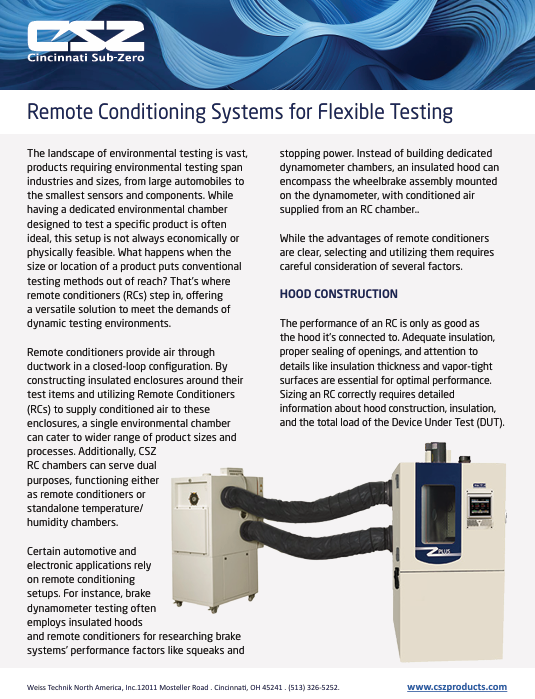
A remote conditioning system uses ducted airflow in a closed-loop configuration to supply temperature-controlled air to an external enclosure or test space.
By combining a Remote Conditioner (RC) with an insulated hood or enclosure, a single chamber can support a wider range of applications and product sizes.
This approach allows testing of:
- Large or irregularly shaped products
- Components that cannot be moved into a chamber
- Systems requiring dynamic or in-place testing
Why Use Remote Conditioning for Environmental Testing?
Remote conditioning systems are designed to overcome the limitations of traditional environmental chambers.
Key advantages include:
- Greater flexibility in testing large or fixed equipment
- Ability to simulate environmental conditions in real-world setups
- More efficient use of existing chamber equipment
- Reduced need for custom-built or oversized chambers
In many applications, RC systems can also function as standalone test chambers or dual-purpose systems.
Key Design Considerations for Remote Conditioning
To achieve accurate and reliable results, several factors must be considered when implementing a remote conditioning system.
Hood Construction
The performance of an RC system depends heavily on the enclosure surrounding the device under test.
Important factors include:
- Proper insulation and sealing
- Vapor-tight construction
- Minimizing air leaks and heat loss
A well-designed hood ensures efficient temperature and humidity control.
Temperature Control
The air temperature delivered to the enclosure may differ from the chamber temperature due to heat generated by system components such as blower motors.
To maintain accuracy, it is important to:
- Use remote temperature sensors
- Account for temperature increases in airflow
- Measure conditions directly at the test location
Humidity Control
Humidity control becomes more complex in remote systems due to temperature fluctuations.
For example, even a small temperature increase can significantly reduce relative humidity levels.
Additional considerations include:
- Introducing humidity closer to the test environment
- Managing moisture retention within materials
- Preventing condensation buildup inside the enclosure
Airflow and System Performance
Airflow plays a critical role in maintaining consistent test conditions.
Factors that influence airflow performance include:
- Hose length and diameter
- Number of bends and restrictions
- Air velocity over the test object
Reducing pressure drop and optimizing airflow design helps improve system efficiency and temperature stability.
Expand Your Testing Capabilities
Remote conditioning systems allow manufacturers and engineers to extend environmental testing beyond the limitations of traditional chambers.
These systems are especially valuable when testing:
- Automotive components such as brake systems
- Large assemblies or integrated systems
- Equipment that must remain in place during testing
By enabling flexible test setups, RC systems support more accurate and realistic testing environments.
Download the Full White Paper
Want a deeper understanding of how remote conditioning systems work and how to optimize them for your application?
Download the full white paper to explore:
- Detailed system design considerations
- Hood construction best practices
- Temperature and humidity control strategies
- Airflow optimization and performance factors