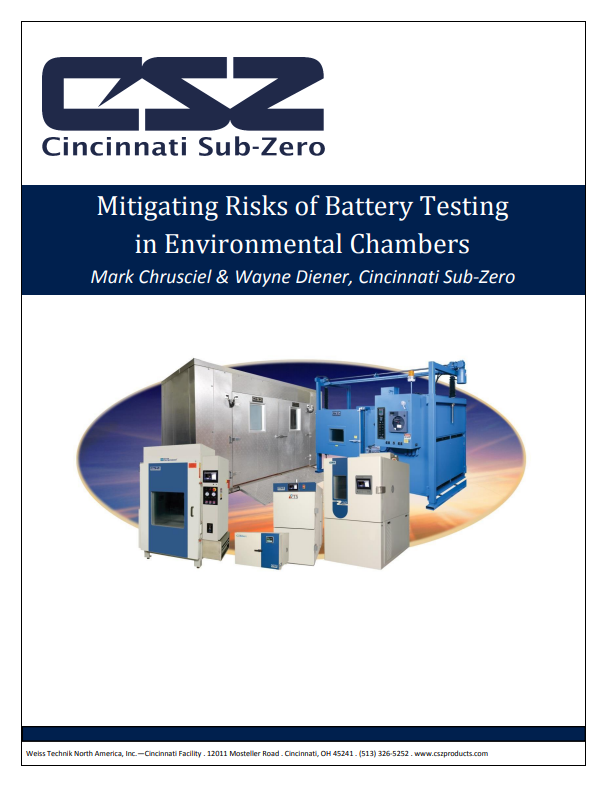
Mitigating Risks of Battery Testing in Environmental Chambers
Battery testing in environmental chambers is critical for validating performance, safety, and reliability. However, testing batteries, especially lithium-ion batteries, introduces unique risks due to their chemistry, failure modes, and potential for hazardous reactions.
Properly managing these risks requires a combination of controlled testing environments, appropriate chamber selection, and integrated safety systems.
Why Battery Testing Requires Specialized Safety Considerations
Battery testing often involves extreme conditions such as high and low temperatures, charging and discharging cycles, and sometimes vibration or humidity. These factors can lead to failure modes such as:
- Overcharging or undercharging
- Overheating
- Internal short circuits or separator failure
In lithium-ion batteries, these failures can trigger thermal runaway, a rapid and self-sustaining reaction that generates heat, pressure, and flammable gases.
Key Risks in Battery Environmental Testing
Testing batteries in environmental chambers presents several safety challenges that must be addressed.
Thermal Runaway and Gas Release
During failure events, batteries can release high-pressure flammable gases in a matter of seconds.
These gases may:
- Ignite or sustain combustion
- Produce oxygen that fuels fire
- Create dangerous pressure conditions inside the chamber
Managing these byproducts is often more critical than stopping the reaction itself.
Pressure and Venting Risks
Battery failures can result in rapid pressure buildup within the chamber.
Standard chamber pressure relief systems may not be sufficient for these events, making it important to:
- Design custom pressure relief solutions
- Ensure proper venting of hazardous gases
- Integrate exhaust systems for safe removal
Variability in Battery Design and Chemistry
There is no one-size-fits-all solution for battery testing.
Different battery types, sizes, and chemistries introduce unique failure modes and risk levels.
This variability requires customized testing approaches and chamber configurations.
Critical Safety Features for Battery Testing Chambers
To mitigate risks, environmental chambers used for battery testing should include specialized safety features.
Common safety enhancements include:
- Temperature-limited sheath heaters to prevent ignition sources
- Non-sparking components such as fan blades and blowers
- Intrinsically safe sensors to prevent electrical sparks
- Removal of internal ignition sources such as lights
Additional safety systems may include:
- Gas monitoring for hydrogen, oxygen, or carbon monoxide
- Nitrogen or CO₂ purge systems to reduce fire spread
- Fire detection and suppression systems
- Reinforced chamber construction for high-risk tests
These features help reduce the likelihood of ignition and improve operator safety.
Designing a Safe Battery Testing Environment
Effective battery testing requires more than just safety features. It involves a comprehensive understanding of the test application and system requirements.
Key considerations include:
- Selecting the appropriate chamber size and capacity
- Accounting for heat load generated by the battery
- Ensuring compatibility with test equipment such as cyclers
- Verifying temperature and humidity performance capabilities
In many cases, designing for worst-case scenarios is recommended when risks are not fully known.
Why Risk Mitigation Is Critical
Battery failures can result in fire, explosion, or hazardous gas release, making risk mitigation essential for both safety and test accuracy.
By implementing the right chamber design and safety systems, manufacturers can:
- Reduce risk during testing
- Protect personnel and equipment
- Ensure regulatory compliance
- Improve reliability and confidence in battery performance
Read the Full White Paper
This overview highlights the key risks and safety considerations involved in battery testing within environmental chambers.
For a deeper dive into battery failure modes, hazard classifications, and advanced safety system design, download the full white paper.
Download the White Paper