Humidity Water Supply & Maintenance for Environmental Test Chambers
Water quality is one of the most important and often overlooked factors in the performance of humidity test chambers and environmental test chambers. In environmental testing, humidity directly affects material properties, making it critical to use the right water type and maintain proper system conditions.
Using untreated or improper water can introduce minerals and contaminants that lead to corrosion, scaling, poor humidity control, and long-term damage to your chamber.
Why Water Quality Matters in Humidity Testing
Public water supplies often contain dissolved minerals, chlorine, and other chemicals that can negatively impact environmental test chambers.
- Hard water can cause scale buildup and calcification
- Over-purified water can lead to corrosion and rust
- Contaminants can reduce test accuracy and repeatability
Maintaining the proper balance of water purity is essential to protect equipment and ensure reliable testing results.
Recommended Water Types for Humidity Systems
For optimal performance, it is recommended to use:
- De-Ionized (DI) Water
- Reverse Osmosis (RO) Water
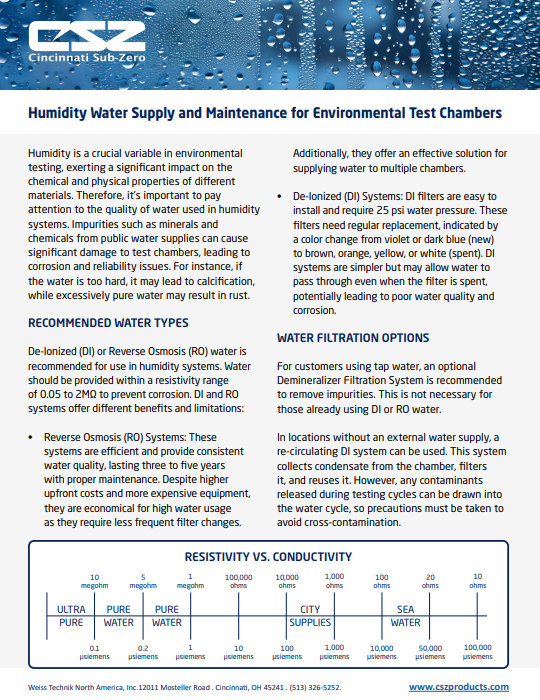
Water should fall within a resistivity range of 0.05 to 2 MΩ to prevent corrosion and mineral buildup.
Reverse Osmosis (RO) Systems
- Deliver consistent, high-quality water
- Offer longer lifespan, typically 3 to 5 years with proper maintenance
- Ideal for high-volume use or multiple chambers
- Require less frequent filter replacement
De-Ionized (DI) Systems
Water Filtration Options
If your facility uses tap water, additional filtration is strongly recommended to remove impurities and extend equipment life.
Common options include:
- Demineralizer filtration systems
- Roughing filters for chlorine, organics, and phosphates
- Recirculating DI systems for closed-loop operation
Recirculating systems can improve efficiency but should be monitored carefully to avoid contamination from test byproducts.
Humidity Chamber Water Usage
Water consumption varies depending on chamber size and testing conditions:
Key factors that affect water usage include:
- Relative humidity (RH) setpoint
- Chamber size and configuration
- Heater capacity (kW)
- Frequency and duration of test cycles
Maintenance Best Practices
Routine maintenance of your humidity water system is essential to prevent downtime and extend chamber life.
- Regularly check water resistivity and contamination levels
- Replace DI filters when cartridges are spent
- Maintain RO systems to prevent shutdowns
- Inspect filtration systems for buildup or wear
Failure to properly maintain water systems can lead to inaccurate testing, equipment damage, and costly repairs.
Water Pressure Requirements
Maintaining proper water pressure is critical for safe and effective operation:
- 25 PSIG for boiler or steam generator systems
- 10 PSIG for atomizing systems
Excess pressure can cause leaks, filter failures, and damage to the chamber. A pressure regulator is strongly recommended.
Optimize Your Humidity Test Chamber Performance
Using the correct water type, implementing proper filtration, and following consistent maintenance practices will help ensure accurate results and maximize the lifespan of your environmental test chamber.
Need help selecting the right water system? Contact our team for expert guidance tailored to your application.
Want more in-depth guidance?
Download the full white paper for detailed specifications, filtration recommendations, and maintenance best practices.