How Product Load Impacts Environmental Test Chamber Selection
Why Product Details Are Critical for Chamber Selection
When selecting an environmental test chamber, it is essential to provide the manufacturer with detailed information about the product being tested.
If key details are missing, the selected chamber may not be suitable for the application and could introduce safety risks. The manufacturer must understand both the product and the test objectives to properly recommend a standard chamber or design a custom solution.
The more complete the information provided, the better the outcome in terms of performance, safety, and overall system accuracy.
Product load in an environmental test chamber includes both static (dead) load and live load, and directly impacts airflow, system sizing, and temperature performance.
Example: Safety Risks in Hydraulic Testing Applications
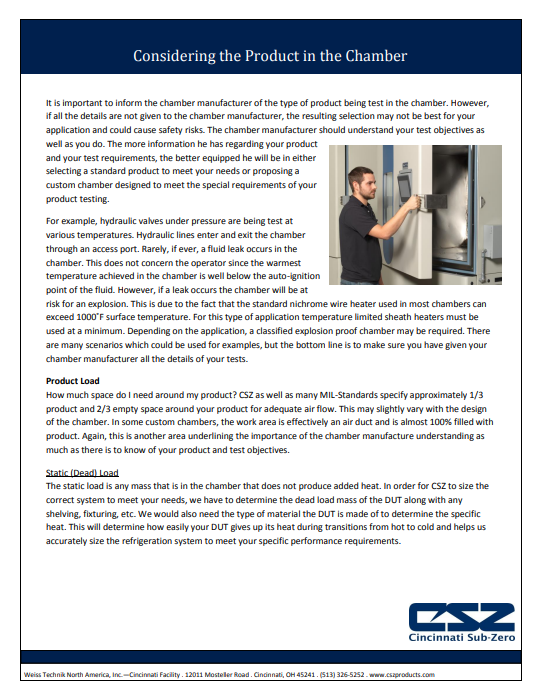
Consider a scenario where hydraulic valves under pressure are tested at various temperatures.
Hydraulic lines enter and exit the chamber through an access port. While fluid leaks may be rare, they can present a serious hazard under certain conditions.
Even if the chamber's operating temperature is below the fluid's auto-ignition point, internal components such as standard nichrome wire heaters can exceed surface temperatures of 1,000°F. If a leak occurs and fluid vapor comes into contact with these high-temperature surfaces, there is a risk of ignition or explosion.
To reduce this risk, applications like this may require temperature-limited sheath heaters and additional safety features based on the specific testing conditions. This example highlights the importance of fully communicating all test parameters to the chamber manufacturer.
Product Load and Airflow Considerations
How Much Space Is Needed Around a Product in an Environmental Test Chamber?
CSZ, along with many MIL-Standards, recommends maintaining approximately one-third product volume and two-thirds open space within the chamber to support proper airflow. This ratio may vary depending on chamber design. In some custom chambers, the workspace effectively functions as an air duct and may be almost completely filled with product.
Proper airflow is essential for maintaining temperature uniformity and ensuring accurate test conditions. To achieve the best performance, manufacturers should understand the product's size, placement within the chamber, and airflow requirements before recommending a solution.
Static (Dead) Load in Environmental Chambers
Static load, or dead load, refers to any mass inside the chamber that does not generate heat. This includes the device under test (DUT), shelving, fixtures, and mounting hardware.
When sizing an environmental test chamber, manufacturers must consider the total mass of all components as well as the material composition of the DUT. Material properties, including specific heat, influence how quickly a product responds to temperature changes and play a key role in determining overall chamber performance.
Live Load and Heat Generation
Live load refers to any heat-generating component inside the chamber and is typically measured in watts.
Because live load adds thermal energy to the test space, it increases the demand placed on the refrigeration system. Heat load represents the total thermal energy generated within the chamber, including both live load and other system factors, and must be accurately calculated during chamber selection.
Failing to account for heat load can prevent the chamber from achieving required temperatures, particularly during rapid temperature transitions or demanding test profiles.
Key Information to Provide for Accurate Chamber Selection
To ensure the chamber is properly sized and configured, manufacturers should be provided with information regarding the maximum static load, maximum live load, material composition of the DUT, shelving requirements, and any fixtures used to support or mount the product.
Providing complete and accurate information helps ensure the selected system meets performance requirements, avoids unnecessary oversizing, and remains cost effective.
Why Proper Sizing Matters
Selecting the correct chamber size and configuration is essential for both performance and operating efficiency.
A system that is not properly sized may struggle to achieve required temperatures, consume more energy than necessary, and increase overall project costs. Improper sizing can also affect long-term reliability and test repeatability.
By providing accurate product and load information early in the specification process, manufacturers can select a chamber that delivers the required performance without unnecessary complexity or expense.
Download the White Paper