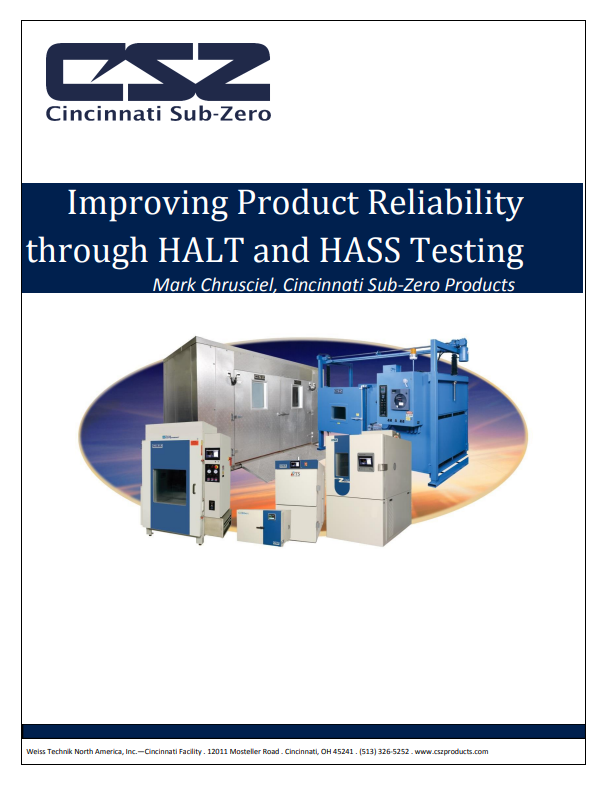
Improving Product Reliability with HALT and HASS Testing
HALT (Highly Accelerated Life Testing) and HASS (Highly Accelerated Stress Screening) are advanced testing methods used to identify product weaknesses early in development and manufacturing. By applying accelerated stress conditions, these techniques help manufacturers improve product reliability, reduce failures, and increase customer confidence.
HALT and HASS are widely used across industries to uncover hidden design flaws and manufacturing defects that could otherwise lead to costly failures in the field.
What Are HALT and HASS Testing?
HALT and HASS are discovery-based testing methods designed to push products beyond their normal operating limits to expose weaknesses.
- HALT (Highly Accelerated Life Testing) focuses on the product design phase, identifying weak points through extreme stress conditions
- HASS (Highly Accelerated Stress Screening) is used in production to detect manufacturing defects before products are shipped
Unlike traditional compliance testing, these methods are designed to find failures quickly, allowing engineers to improve designs and processes.
Key Benefits of HALT and HASS Testing
Accelerated testing provides significant advantages for product development and manufacturing:
- Identifies design flaws early in development
- Detects manufacturing defects before shipment
- Improves product durability and robustness
- Reduces time to market and development costs
- Increases mean time between failures (MTBF)
In many cases, HALT testing has achieved substantial improvements in product reliability and lifecycle performance.
How HALT Testing Improves Product Design
HALT uses a combination of environmental stresses such as temperature, vibration, humidity, and electrical input to identify weak links in a product.
These stresses are applied at levels beyond normal operating conditions to accelerate failure and reveal design limitations.
Through this process, engineers can:
- Determine operational and destruct limits
- Identify failure modes quickly
- Improve product design margins
- Enhance long-term reliability
Applying multiple stresses simultaneously is especially effective, as combined conditions can uncover the majority of product defects.
HASS Testing for Manufacturing Quality
While HALT focuses on design, HASS ensures consistent quality during production.
HASS applies accelerated stresses determined during HALT to quickly identify defective units. This allows manufacturers to:
- Detect early-life failures before products reach customers
- Reduce warranty claims and field failures
- Improve production processes and consistency
- Lower screening and testing costs
By shortening the time to failure, HASS enables faster corrective action and improved manufacturing efficiency.
The HALT and HASS Process
HALT and HASS follow a structured process to improve product reliability:
- Precipitation – Convert hidden defects into detectable failures
- Detection – Identify and confirm failures
- Failure Analysis – Determine root cause of issues
- Corrective Action – Improve design or manufacturing process
- Verification – Confirm that fixes resolve the issue
- Knowledge Capture – Document findings for future improvements
This cycle ensures continuous improvement and helps organizations build more robust and reliable products over time.
Why Accelerated Testing Matters
Traditional testing methods often fail to uncover weaknesses until products are already in the field. HALT and HASS provide a proactive approach by identifying and resolving issues early.
By increasing design margins and eliminating weak points, companies can:
- Improve product reliability at launch
- Reduce costly redesigns and recalls
- Enhance customer satisfaction
- Gain a competitive advantage in the market
Read the Full White Paper
This overview highlights how HALT and HASS testing improve product reliability and manufacturing quality.
For a deeper dive into accelerated stress testing methods, implementation strategies, and real-world applications, download the full white paper.
Download the White Paper